BHARATIYA INSTITUTE OF HUMAN EXCELLENCE

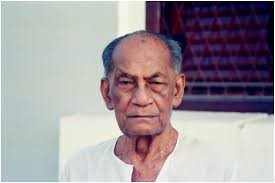
NIROD BARAN
My Meeting with Nirodbaran
Dr. Nirodbaran (17 November 1903 - 17 July 2006), popularly called Nirod-da in the Ashram, went to Edinburgh to study medicine in 1924. Although soon after his return in 1930, he went to Pondicherry, he felt that he was not made for spiritual life, but simply for "karma yoga." He became a successful medical practitioner in Rangoon, and material progress sent spirituality as well as karma yoga into oblivion. The awakening came when the police searched his house, possibly because in their records he was still a suspicious character because, as a young boy, he had served a two-month sentence in jail due to his involvement in the freedom struggle. Soon after that he lost his job, and things went from bad to worse. After two years of struggle, he finally decided to take refuge in Sri Aurobindo and the Mother at Pondicherry. After Sri Aurobindo had a fracture of the leg in 1938, Nirod-da not only took care of him as a medical person, but also became the scribe to whom Sri Aurobindo started dictating 'Savitri'. His work as a scribe continued till 1950 when Sri Aurobindo left the body. After 1950, the Mother asked Nirod-da to teach in the school, where he taught French, English and Bangla. He kept himself in good health even in his nineties, was humble, and always available as an elder brother to all those who were in the Ashram or visited the Ashram. (Based on Sunayana Panda: 'Seven Dedicated Lives' pp. 2-8) At first sight Nirodbaran looks an ordinary man. You may not feel encouraged to meet him. He is unassumingly simple. Outwardly he behaves in a very restricted manner.But you need to reach into the depths of the heart of this frail man of advanced years to find a pearl as in an oyster.
Nirodbaran's journey from medical science at Edinburgh to spiritual science in Pondicherry, from rational to suprarational, paid him rich dividends in terms of spiritual gain. Since his coming to Pondicherry in the early thirties in search of a quiet spiritual life, he never looked back: he burnt his boats. The inner spiritual world of Nirodbaran is shrouded in mystery. My effort to bring out his hidden spiritual experiences met with but little success.
The grace of his Guru Sri Aurobindo came upon Nirodbaran in a very peculiar way. Just before the 1938 November Darshan, Sri Aurobindo met with an accident. He needed special care and Nirodbaran was called upon to serve him in his capacity as a physician. By this time he had already built up an intimate relationship with Sri Aurobindo through correspondence with him. And now a new vista of life's realisations opened up. For twelve long years he served his Master with unflinching devotion and steadfastness. In his own words, "knowledge, love and bliss which intermittently poured out from Sri Aurobindo was sufficient reward he accorded to us for the humble services we rendered."
Apart from mystic poetry written under Sri Aurobindo's inspiration, Nirodbaran has a number of books to his credit that reveal different facets of Sri Aurobindo's divine personality. Nirodbaran's room is in an enviable location, overlooking Sri Aurobindo's Samadhi where hundreds of devotees offer their obeisance to the Divine. Proper utilisation of time has always been high on his agenda. If one wants to meet him one has to face a barrage of questions before he is invited. He is like a tortoise who comes out of the shell only when a friendly signal is given. With an expectant mind I approached him for an interview. He tried to impress upon me the futility of such interviews, but I was able to convince him of their usefulness for the readers.
Excerpts from the interview:
Q. You have been a close associate of Sri Aurobindo. Do you feel a vacuum due to his physical absence?
A. I do feel a vacuum at times. At other times I feel his divine Presence which gives me peace, calm and a sense of joy.
Q. Can you recollect your first meeting with Sri Aurobindo?
A. There was no meeting, my friend. I had a darshan of Sri Aurobindo in 1930. Sri Aurobindo, as the Mother said, was an Avatar of Supermind. When I saw him I felt that he possessed a great Power and could do anything he wanted. At the same time, he was very simple, majestic, calm and loveable, giving me the impression of Lord Shiva.
Q. You are one of the Old Guards of Sri Aurobindo's era. What is your assessment of the progress of the Ashram since Sri Aurobindo's Mahasamadhi?
A. Things have progressed a lot, internally as well as externally. It is the inner development to which we are giving top priority. The Ashram exists not so much by the outer as by inner growth. In this respect it is different from secular institutions. It is growing from strength to strength. The inner growth is not a thing that one can see through the mind or the physical eye. Though the Mother and Sri Aurobindo are not present physically, the Ashram is packed with their divine Presence and Power.
Q. How far, in the light of Sri Aurobindo's teachings, have you succeeded in transforming your ordinary nature and gained control over your instincts?
A. Transformation of the personality and things like that seem to be a distant goal. If I had no control over my natural instincts how could I remain here without getting disturbed by various temptations? I have been invited to Calcutta and Delhi a number of times but I declined to go. I have taken up work and I have been doing it; that is all.
Q. How do you view the collective sadhana that is being practised here in the Ashram?
A. These are very private things. In fact you should see for yourself the life here. There is so much freedom. People are impressed by what they see. They have not seen children so happy anywhere else. There is so much discipline. Children live here as brothers and sisters, as the Mother's Children - that is so patently clear. Not that the system is perfect, but everybody is happy to see such a harmony in the Ashram without any apparent control. Here boys and girls mix freely but not in the way of the world. I am talking of the inmates of the Ashram. But there are plenty of outsiders who are also devotees of the Mother and who have settled here. Those who visit the Ashram see only the outside - they have no inner eye to see the Truth. They go by superficial signs.
Q. Do you think that the books written by Sri Aurobindo and the Mother are sufficient for spiritual aspirants to do the integral yoga unaided by a living guru?
A. I have told you that although physically they are not here, subtly they are present - we do get indications from them. If you are sincere, you get their directions as and when you are in need of it.
Q. Renunciation is a very important aspect of traditional yoga. But here I find that this aspect is missing, at least outwardly. Don't you think that without renunciation common people may misunderstand the principles of sandhana?
A. Let me tell you that it is the inner renunciation that is needed for doing Sri Aurobindo's yoga, not the outer. In that sense his yoga is new. Since we have accepted his yoga, naturally the emphasis is on inner renunciation. It does not mean that outwardly we will enjoy life and say we have renounced. Everything is done in the inner being. It is not the renunciation of the Sanyasin. Do you follow? We do not set examples. It is our own life that we have to live. There is no scope for pretension. Sincerity is the question. Everything depends on that. Don't you think that to become sincere is so easy! Sincerity has to be practised. Secondly, Sri Aurobindo himself has said that his yoga is new - he is not following the traditional path. This newness lies in the acceptance of the life and world in a modified way - not the path of the Sanyasins who have rejected the world and have gone away to the Himalaya or to lonely retreats. The Mother and Sri Aurobindo, by accepting the world, want to change it. So the dangers and pitfalls may be there but we have to face them and try to conquer them. The help of our Gurus is with us. So this yoga is an inner movement and not an outer one. That is why we give so much importance to inner renunciation.
Q. Those who want to do Sri Aurobindo's yoga, what advice would you give them?
A. The Mother has said that you must feel the Call for this yoga. You must be sure of it. Then all the rest will follow.
(Reproduced from The Call Beyond, Vol. 18, No.3, 1993, pp.25-26)